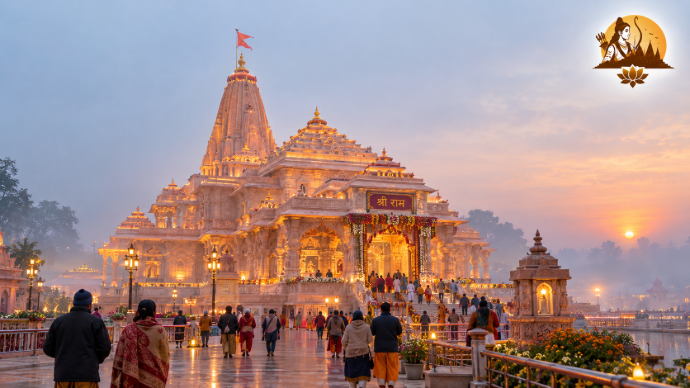
The history of Ayodhya Ram Mandir spans over five centuries of religious faith, historical shifts, and prolonged legal proceedings. According to Hindu tradition, Ayodhya is the sacred birthplace of Lord Shri Ram (Ram Janmabhoomi). Following centuries of dispute over the site, India's Supreme Court delivered a landmark unanimous verdict in 2019, paving the way for the grand temple's construction and its consecration in January 2024.
1. The Historical Background of Ram Janmabhoomi
What is the historical significance of the Ram Janmabhoomi site in Ayodhya? Situated along the banks of the sacred Sarayu River in Uttar Pradesh, Ayodhya holds a revered status in ancient Indian heritage as the birthplace of Lord Shri Ram. For centuries, pilgrims have venerated the site as a core center of spiritual devotion.
Historical and court records document that in 1528, during the reign of the first Mughal Emperor Babur, a mosque known as the Babri Masjid was constructed at the site under the supervision of his commander, Mir Baqi. Over the subsequent centuries, Hindu devotees maintained continuous worship in the outer courtyard, believing the inner area marked the precise birth spot of Lord Ram.
During the British colonial period and post-independence India, competing legal claims over the 2.77-acre plot evolved into one of the country's longest-running land title suits, bridging archaeological findings, historical documentation, and constitutional law.
2. Ayodhya Ram Mandir: Complete 500-Year Chronological Timeline
How did the Ayodhya site evolve over 500 years? The historical transition from the initial dispute to the legal resolution and temple consecration is outlined in the chronological timeline below:
| Date / Year | Historical Event & Legal Milestone |
| 1528 | Construction of the Babri Masjid under the direction of Mir Baqi during Emperor Babur's reign. |
| 1856–1857 | Following local disputes, the British colonial administration erects a rail fencing to separate inner and outer courtyards. |
| 1885 | Mahant Raghubar Das files the first formal civil suit seeking permission to build a canopy on the Ram Chabutra; the suit is dismissed. |
| December 1949 | Idols of Ram Lalla are placed beneath the central dome. The premises are locked and placed under legal receivership under Section 145 CrPC. |
| 1986 | The District Court orders the gates opened to allow Hindu devotees to offer prayers inside the complex. |
| December 6, 1992 | The disputed structure is demolished during a mass political rally, leading to major socio-legal shifts across the nation. |
| 2003 | The Archaeological Survey of India (ASI) conducts excavations under court orders, discovering structural remains of a pre-existing non-Islamic building. |
| September 30, 2010 | The Allahabad High Court orders a three-way partition of the 2.77-acre land among the Sunni Waqf Board, Nirmohi Akhara, and Ram Lalla Virajman. |
| November 9, 2019 | The Supreme Court of India delivers a landmark unanimous 5-0 verdict awarding the entire 2.77-acre land for temple construction and allocating an alternative 5-acre plot for a mosque. |
| August 5, 2020 | Prime Minister Narendra Modi performs the Bhoomi Pujan (groundbreaking ceremony), initiating formal construction under the Shri Ram Janmabhoomi Teerth Kshetra Trust. |
| January 22, 2024 | The Pran Pratishtha (consecration ceremony) of the idol of Shri Ramlalla is performed, opening the temple to global pilgrims. |
3. The 2019 Supreme Court Verdict: What Did the Court Decide?
What was the exact outcome of the 2019 Ayodhya Supreme Court case? On November 9, 2019, a five-judge Constitution Bench of the Supreme Court of India, headed by then Chief Justice Ranjan Gogoi, delivered an authoritative, 1,045-page unanimous judgment resolving the long-standing title dispute.
Key aspects of the ruling include:
Title Awarded to Deity: The entire 2.77-acre disputed land was awarded to the deity, Ram Lalla Virajman.
Creation of Temple Trust: The Central Government was directed to form a public trust to oversee temple planning and construction, resulting in the establishment of the Shri Ram Janmabhoomi Teerth Kshetra Trust.
Alternative Allocation for Mosque: The court mandated the government to allocate a prominent alternative 5-acre plot of land in Dhannipur, Ayodhya, to the Sunni Central Waqf Board for constructing a mosque and community facilities.
Evidence-Based Finding: The judgment relied on continuous possessory records, historical traveler accounts, and scientific evidence from the Archaeological Survey of India (ASI), which indicated that the underlying structure was not of Islamic origin.
4. Ram Mandir Architecture: Structural Design and Key Features
What architectural style is used in the Ayodhya Ram Mandir? The temple is constructed in the traditional Nagara style of North Indian temple architecture, designed by renowned chief architect Chandrakant Sompura along with his sons Ashish and Nikhil Sompura.
Core Structural Specifications:
Dimensions: The grand complex measures 380 feet in length (east-to-west), 250 feet in width, and rises to a height of 161 feet at the primary peak (Shikhara).
Pillars and Doors: Constructed across three storeys, the temple features 392 sculpted pillars and 44 gold-plated wooden doors.
Five Mandaps (Halls): The layout features five distinct halls—Nritya Mandap, Rang Mandap, Sabha Mandap, Prarthana Mandap, and Kirtan Mandap.
Traditional Engineering: Built using Bansi Paharpur pink sandstone from Rajasthan, high-density granite, and teak wood. The structure uses no iron or steel, engineered to withstand seismic events and endure for over 1,000 years.
Sanctum Sanctorum (Garbha Griha): Houses the 51-inch idol of 5-year-old Shri Ramlalla (Balak Ram), carved out of dark Shaligram stone by Karnataka sculptor Arun Yogiraj.
5. Ram Lalla Pran Pratishtha: January 22, 2024
When did the Pran Pratishtha of Ram Mandir take place? The consecration ceremony (Pran Pratishtha) of the idol of Shri Ramlalla occurred on January 22, 2024, marking the official completion of the main sanctum.
In sacred Vedic traditions, Pran Pratishtha is the ritual process through which divine life force is invoked into a sculpted deity image. Led by scholars from Varanasi alongside Prime Minister Narendra Modi and religious leaders from across various traditions, the event marked the formal opening of the shrine to millions of devotees worldwide.
6. Cultural and Historical Significance Today
Why is the Ayodhya Ram Mandir significant today? Beyond its deep religious role for millions of devotees, the temple complex has revitalized Ayodhya’s infrastructure and cultural landscape.
The development has elevated Ayodhya into a major national and international pilgrimage center, spurring regional infrastructure upgrades such as the Maharishi Valmiki International Airport and modernized railway corridors. The influx of visitors has created economic opportunities in hospitality, transportation, and traditional crafts throughout Uttar Pradesh.
When planning a pilgrimage to the city, explore our dedicated travel guide on Places to Visit in Ayodhya.
7. Frequently Asked Questions (FAQs)
1. What is the history of Ayodhya Ram Mandir?
The history of Ayodhya Ram Mandir involves centuries of spiritual devotion at Ram Janmabhoomi, a 16th-century mosque construction, legal disputes starting in 1885, a landmark 2019 Supreme Court ruling, and consecration in January 2024.
2. When was the Supreme Court verdict on Ayodhya delivered?
The Supreme Court of India delivered its unanimous judgment on November 9, 2019, awarding the land for temple construction and allocating 5 alternative acres for a mosque.
3. Who designed the Ayodhya Ram Mandir?
The temple was designed by chief architect Chandrakant Sompura along with his sons Ashish and Nikhil Sompura, carrying forward a family legacy of traditional Nagara temple design.
4. What architectural style is used for the temple?
The Ram Mandir is built in the traditional Nagara architectural style of Northern India, characterized by multi-tiered carved pillars, grand Mandaps, and a soaring central Shikhara.
5. When did the Ram Lalla Pran Pratishtha take place?
The historic Pran Pratishtha ceremony took place on January 22, 2024, consecrating the idol of 5-year-old Shri Ramlalla in the main sanctum sanctorum.
6. How many pillars and doors are in the Ram Mandir?
The three-storeyed temple structure includes 392 carved pillars and 44 gold-plated teakwood doors.
Internal Linking Recommendations
To enhance site navigation and topical authority on Ayodhya Nagari, integrate the following contextual links in related content:
Places to Visit in Ayodhya: Suggest this guide when covering local sightseeing itineraries. (Anchor text: "Places to Visit in Ayodhya")
Ayodhya Travel Guide: Link within logistical planning sections. (Anchor text: "Ayodhya Travel Guide")
Hanuman Garhi & Kanak Bhawan: Contextual references when describing surrounding sacred heritage sites. (Anchor text: "Hanuman Garhi")