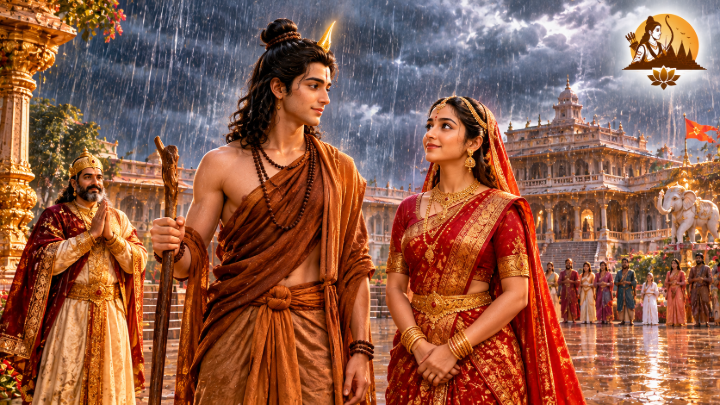
Who was Lord Rama's elder sister in the Ramayana?
Lord Rama had an elder sister named Devi Shanta. She was the firstborn child of King Dasharatha and Queen Kausalya of Ayodhya. Known for her immense beauty, intellect, and knowledge of the Vedas, she was later adopted by King Romapad of the Anga Kingdom and played a crucial role in the birth of her younger brothers.
Why did King Dasharatha give his daughter Shanta for adoption?
King Romapad of Anga and his wife Vershini (Queen Kausalya's elder sister) were childless. Seeing their sorrow, King Dasharatha and Queen Kausalya made the ultimate sacrifice and gave their beloved firstborn, Devi Shanta, to them in adoption. She was raised as the princess of Anga with great love and care.
How did Devi Shanta marry Sage Rishyasringa?
When the Anga kingdom was struck by a severe drought, it was prophesied that only the presence of a pure, celibate ascetic could bring rain. Devi Shanta helped bring the isolated, pure-hearted Sage Rishyasringa to Anga. As he entered, torrential rains saved the kingdom. In immense gratitude, King Romapad offered Princess Shanta's hand in marriage to the great sage.
(Ramayana Untold Stories Cluster)
To establish topical authority on Google for this niche, this blog fits into the following semantic structure:
Pillar Page: The Complete Lineage and Family Tree of Lord Rama
Cluster 1 (Ancestors & Siblings): Devi Shanta (Elder Sister), King Dasharatha's Oaths, The story of Iksvaku Dynasty.
Cluster 2 (Crucial Events): Putrakameshti Yajna, The Drought of Anga Kingdom.
Cluster 3 (Key Sages): Sage Rishyasringa, Sage Vasishtha, Sage Vishwamitra.
The Untold Epic: The Complete Story of Devi Shanta
The Ramayana is a vast ocean of stories, but some pearls remain hidden deep within its verses. While the world reveres Lord Rama, Lakshmana, Bharata, and Shatrughna, very few know about the eldest sibling of the Raghu dynasty—Devi Shanta. Her life is a powerful saga of sacrifice, duty, and divine intervention that set the very foundation for Lord Rama's incarnation.
The Birth of a Brilliant Princess
Long before the birth of the four brothers, joy echoed in the halls of Ayodhya when Queen Kausalya gave birth to a daughter. Named Shanta, she was not just an ordinary royal child. As she grew, she mastered the Vedas, arts, crafts, and statecraft. She was the apple of King Dasharatha's eye, bringing warmth and light to the grand palaces of the Ikshvaku dynasty.
The Supreme Sacrifice of Adoption
The neighboring kingdom of Anga was ruled by King Romapad, a close friend of Dasharatha. Romapad's queen, Vershini, was the elder sister of Kausalya. During a visit to Ayodhya, Vershini expressed her deep sorrow over being childless. Bound by familial love and royal dharma, King Dasharatha made a heart-wrenching promise. He vowed to give his firstborn daughter, Shanta, to Romapad and Vershini.
True to the word of a Suryavanshi king, Shanta was sent to Anga. She gracefully accepted her new life, bringing immense joy to her adoptive parents and becoming the beloved Princess of Anga.
The Terrible Drought in the Anga Kingdom
Years passed, and a grave crisis struck the Anga kingdom. A Brahmin was insulted in King Romapad's court, causing the rain gods to curse the land. Rivers dried up, crops withered, and the citizens faced devastating famine. The royal astrologers and priests revealed that the curse could only be broken by the footsteps of a perfectly pure, celibate ascetic who had never experienced the worldly illusions of anger or lust.
The Legend of Sage Rishyasringa
The priests pointed to Sage Rishyasringa, the son of the great Sage Vibhandaka. Raised deep in a remote forest, Rishyasringa had never seen another human being other than his father, let alone a woman. He possessed a unique physical trait—a single horn on his forehead, symbolizing his untainted spiritual power.
Bringing him to Anga was a seemingly impossible task, as his fiercely protective father would curse anyone who interrupted his son's penance.
Devi Shanta's Role and the Divine Rain
Recognizing her duty to her kingdom, Princess Shanta took charge of the delicate mission. (In some textual variations, she leads a group of graceful women disguised as hermits; in others, she goes herself). Using her intellect, patience, and gentle demeanor, she approached the young sage's hermitage when his father was away.
Fascinated by her gentle nature and completely unaware of gender differences, Rishyasringa felt an unexplainable spiritual bond. He was gently persuaded to step out of his forest and visit the Anga kingdom. The exact moment Sage Rishyasringa's feet touched the dry soil of Anga, dark clouds gathered, and heavy, life-saving rains poured over the parched lands. The kingdom was saved.
The Divine Union and Marriage
Overjoyed by the miracle and deeply indebted to the young sage, King Romapad offered him the most precious thing he had—his daughter. Recognizing her own destiny, Devi Shanta willingly married Sage Rishyasringa. They lived a pious and spiritually elevated life in an ashram, far away from royal luxuries.
The Ultimate Purpose: The Putrakameshti Yajna
Decades later, King Dasharatha of Ayodhya faced the same sorrow that once plagued Romapad—he had no heir to the throne. Advised by Sage Vashistha, Dasharatha realized that only a highly evolved soul like his son-in-law, Sage Rishyasringa, could perform the complex Putrakameshti Yajna (a fire sacrifice for obtaining a son).
Dasharatha traveled to Rishyasringa’s ashram, where he met his daughter Shanta after many years. He pleaded with the couple to come to Ayodhya. Shanta and Rishyasringa agreed. The grand Yajna was performed with flawless precision by the sage. From the sacrificial fire emerged a divine figure holding a bowl of sacred dessert (Payasam), which was distributed among Dasharatha’s queens.
This divine ritual, orchestrated by Devi Shanta’s husband, finally led to the birth of Lord Rama, Bharata, Lakshmana, and Shatrughna. Thus, the sister who was given away in her childhood became the very reason her legendary brothers were born.
Frequently Asked Questions (FAQs)
1. Is Devi Shanta mentioned in the original Valmiki Ramayana? Yes, Devi Shanta is mentioned in the Bala Kanda of the Valmiki Ramayana. Her adoption by King Romapad and the subsequent arrival of Sage Rishyasringa to perform the Putrakameshti Yajna are documented in the early chapters of the epic.
2. Where is the temple of Devi Shanta and Sage Rishyasringa located? A famous temple dedicated to Devi Shanta and Sage Rishyasringa is located in Kigga, a small town near Sringeri in Karnataka, India. Devotees often visit the temple to pray for rain and agricultural prosperity.
3. Did Lord Rama ever meet his elder sister Shanta? According to regional puranas and folklore, Lord Rama, along with his brothers and Goddess Sita, visited Devi Shanta and Sage Rishyasringa to pay their respects and seek their blessings after the royal marriages in Mithila.
4. Why did Sage Rishyasringa have a horn on his head? "Rishya" translates to deer, and "Sringa" means horn. According to mythology, he was born to Sage Vibhandaka and an apsara (celestial nymph) who took the form of a deer, resulting in him being born with a small deer-like horn on his forehead, a mark of his divine origins.
5. Why is Devi Shanta not as famous as Lord Rama? The Ramayana primarily focuses on the journey, dharma, and incarnation of Lord Vishnu as Rama to defeat Ravana. Devi Shanta’s story serves as a crucial prologue—the foundational sacrifice that made the rest of the epic possible.