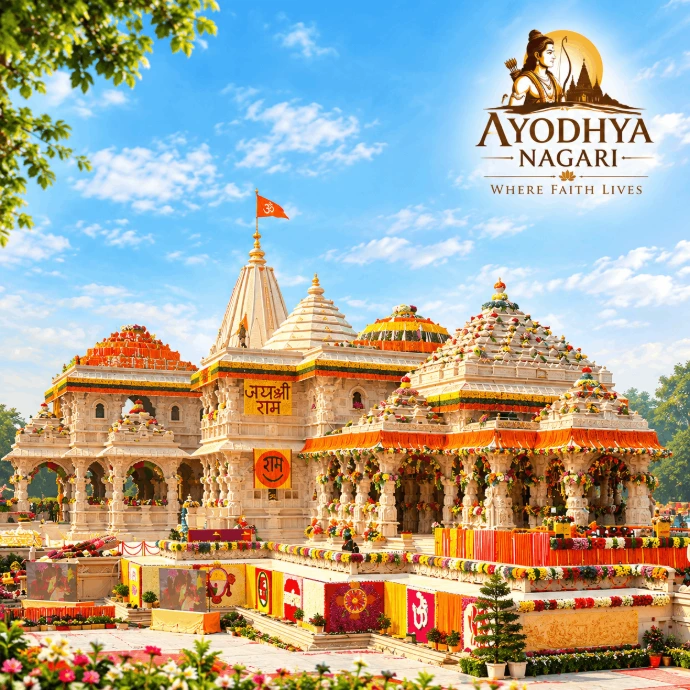
Can You Explore Ayodhya in One Day?
Yes. One day can give you a meaningful introduction to Ayodhya if you concentrate on a practical central route instead of trying to cover every attraction.
A sensible plan is to use the morning for the Ram Mandir area, Hanuman Garhi and Kanak Bhawan, keep the middle of the day for food and rest, and reserve the evening for Ram Ki Paidi and the Saryu riverfront. The exact order should remain flexible because temple entry procedures, crowd conditions and local movement can change.
A realistic one-day Ayodhya route
The route below is an itinerary framework, not a promise of exact darshan or opening times. Build your day around whatever current official entry window is available when you travel.
Ram Mandir area
Start with the main temple visit and allow enough time for security, entry and walking.
Hanuman Garhi + Kanak Bhawan
Continue with nearby central religious and cultural stops instead of crossing the city repeatedly.
Rest → Ram Ki Paidi
Take a proper break and keep the evening for the Saryu riverfront experience.
On this page
1-Day Ayodhya Itinerary
Think of the timings below as planning windows. They help you understand the rhythm of the day; they are not official temple opening or darshan timings.
Start early and get ready for the central route
Practical tip: Do not build the entire day around a perfect minute-by-minute schedule. The first major visit can take longer than expected.
Ram Mandir area
Make the central Ram Mandir visit the anchor of the morning. The important point is not to assume that the published temple schedule equals the amount of time you will personally need.
Travel note: Current darshan arrangements can change. Check the official Shri Ram Janmabhoomi Teerth Kshetra information before leaving for the temple.
Check the official Shri Ram Janmabhoomi Teerth Kshetra website →
Hanuman Garhi
Continue to Hanuman Garhi rather than adding a distant attraction immediately after the main temple visit. The District Ayodhya tourism site identifies Hanuman Garhi as a religious tourist place and notes its proximity to Ayodhya railway station.
Kanak Bhawan
Kanak Bhawan works well as the next central stop. The District Ayodhya tourism site places it to the north-east of Ram Janmabhoomi in Ramkot and categorizes it as both historic and religious.
Lunch + proper rest
This is not wasted sightseeing time. In a one-day Ayodhya trip, a short reset can prevent the evening part of the itinerary from becoming tiring.
Ram Ki Paidi and the Saryu riverfront
End the central itinerary around Ram Ki Paidi and the Saryu riverfront. The District Ayodhya tourism site describes Ram Ki Paidi as a series of ghats on the bank of the Saryu and notes its floodlit appearance at night.
Leave a real departure buffer
If you are returning by train, flight or road the same day, do not treat your departure time as the time you should leave the last attraction.
Keep additional time for local traffic, finding your vehicle, walking back from the riverfront and unexpected delays.
Why This Route Works
The route is designed around geography and visitor flow rather than a search-volume list of attractions.
Keep the central part of the day concentrated
Ram Mandir, Hanuman Garhi and Kanak Bhawan can be treated as the central portion of the day rather than repeatedly travelling to different edges of the city.
Protect time for entry procedures
A temple visit is not simply the time spent inside. Security, queues, walking and visitor procedures can affect the schedule.
Do not spend the entire day moving
A one-day trip becomes less useful when every available minute is assigned to another attraction.
Save the riverfront for a slower finish
Ram Ki Paidi and the Saryu riverfront provide a different experience from temple-hopping and naturally give the day a quieter final phase.
Don't overpack your day. With one day, the goal is not to collect checkmarks. The goal is to experience a sensible part of Ayodhya without spending the whole day travelling from one place to another.
If I Had Only One Day in Ayodhya
If my time in Ayodhya were limited to a single day, I would rather see fewer places properly than spend the day rushing between a long list of attractions.
That is the thinking behind this route. The main temple visit deserves enough breathing room. After that, nearby religious places make more sense than immediately travelling across the wider city. Then the afternoon break protects the evening, which is when the Saryu riverfront can become the natural closing part of the day.
While putting this itinerary together, I wanted to avoid creating a schedule that looks impressive on paper but becomes difficult for an actual traveller to follow. A useful itinerary should tell you what to leave out as clearly as it tells you what to see.
This approach is also consistent with the editorial purpose behind Ayodhya Nagari: make practical Ayodhya information easier to understand, verify important details where possible and distinguish current visitor information from information that can change.
What I Would Prioritize
Give the Ram Mandir visit enough time
Do not make the main visit a rushed checkbox. Entry, security and visitor flow can take longer than expected.
Group nearby central attractions
Hanuman Garhi and Kanak Bhawan make more sense in a concentrated central route than as isolated stops.
Protect an afternoon break
Rest is part of a practical pilgrimage itinerary, especially for families and older travellers.
Keep the Saryu riverfront for the evening
This creates a different pace and avoids making the entire day feel like a sequence of temple entries.
What I Would Skip on a One-Day Ayodhya Trip
“Skip” does not mean “not worth visiting.” It means that adding another location may make the one-day route less comfortable.
Guptar Ghat
Guptar Ghat is an important Ayodhya location, but if adding it forces you to compress the central temple route, consider keeping it for another visit or a longer itinerary.
Additional heritage locations
Places such as Gulab Bari and other heritage attractions can be valuable additions for travellers with a strong history interest, but they do not have to be forced into the same one-day pilgrimage route.
Too many smaller temples
A long list of short stops can consume more time in movement, finding entrances and parking than the visit itself.
Optional shopping detours
Shopping can be added if you have genuine spare time. It should not displace the main itinerary if this is your only day in Ayodhya.
How to Get Around Ayodhya in One Day
The best transport choice depends on your group, walking comfort, crowd conditions and where you are staying. Local prices can vary, so this guide deliberately does not publish fixed fares.
Walking
Useful for nearby central areas where walking is practical. It can also be useful around pedestrian-heavy temple zones.
Best for:Short nearby connections and travellers comfortable with walking.
E-rickshaw / Auto
Useful for short local connections when walking between stops would consume too much time or energy.
Best for:Families, short transfers and flexible local movement.
Private vehicle
Can be convenient for a broader itinerary, but vehicle access and parking near busy visitor areas should be checked on the day.
Best for:Groups carrying more belongings or combining central and peripheral stops.
Do not plan local transport around an exact fare unless you have verified it recently. Prices, availability, access restrictions and traffic conditions can change.
Where to Fit Food & Rest Into a One-Day Plan
Food does not need to become another sightseeing category. The practical objective is to give yourself enough time to eat, hydrate and reset before the evening.
Keep breakfast simple
If you are starting early, avoid turning breakfast into a long detour before the first major visit.
Make lunch the main break
Plan a proper lunch and rest window rather than eating while constantly moving between attractions.
Keep the final stop flexible
If you have a departure to catch, do not let the evening meal or shopping push your return journey too close to the deadline.
Water + battery matter
Carry water where permitted and keep your phone charged, especially if you depend on navigation or digital travel information.
Travelling With Family
Reduce the number of stops
Children usually benefit more from a comfortable route than from a long checklist of attractions.
Add buffer time
Keep more time than you think you need for walking, food, waiting and getting everyone together again.
Use the afternoon wisely
A proper lunch and rest period can make the evening much easier for the whole family.
Keep the evening simple
Ram Ki Paidi and the riverfront can work as a relaxed final stop instead of adding several more locations.
Travelling With Elderly Parents
A one-day Ayodhya itinerary should be slowed down when an older traveller is part of the group. This is not about seeing less of Ayodhya; it is about making the route workable.
Travelling With Children
The same basic route works with children, but the day should have fewer hard deadlines. Food, water, shade or comfortable waiting areas and rest breaks can matter more than squeezing in another attraction.
- Keep the itinerary flexible.
- Do not schedule back-to-back temple visits without a break.
- Carry only what is permitted around temple entry areas.
- Check current security restrictions before arriving.
- Keep the final departure buffer generous.
What If I Reach Ayodhya Late?
Do not try to compress the full itinerary into fewer hours. Remove stops instead.
If your Ram Mandir visit is tied to a later official entry window, shift the rest of the day accordingly rather than trying to force every attraction into the remaining hours.
What Cannot Realistically Fit in One Day?
You can technically create a list containing many Ayodhya attractions, but that does not make it a good itinerary.
Multiple distant locations
Every extra cross-city transfer takes time away from the actual places you came to experience.
Long temple queues + many additional temples
A main darshan visit can change the entire day's rhythm. Keep optional temples genuinely optional.
Detailed heritage sightseeing
A history-focused trip deserves more time than a single pilgrimage day usually allows.
Peripheral ghats + central route + shopping
These can all be valuable, but combining everything can turn a relaxed day into a transport schedule.
Practical Tips for a One-Day Ayodhya Trip
Before travelling, verify temple timings, entry procedures, security arrangements, visitor facilities and local transport. This page is an itinerary framework, not a replacement for current official notices.
For Ram Mandir information, use the current information issued through the Shri Ram Janmabhoomi Teerth Kshetra's official channels.
Official Shri Ram Janmabhoomi Teerth Kshetra website →1 Day Ayodhya FAQs
Is one day enough for Ayodhya?
One day can provide a meaningful introduction to Ayodhya if you concentrate on a practical central route and avoid trying to cover every attraction.
What can I see in Ayodhya in one day?
A practical one-day plan can focus on the Ram Mandir area, Hanuman Garhi, Kanak Bhawan and an evening visit to Ram Ki Paidi and the Saryu riverfront, subject to current timings and crowd conditions.
What is a practical one-day Ayodhya itinerary?
Start with the central Ram Mandir area, continue to Hanuman Garhi and Kanak Bhawan, take an afternoon food and rest break, and keep the evening for Ram Ki Paidi and the Saryu riverfront.
What should I visit first in Ayodhya?
For a one-day plan, starting with the central Ram Mandir area makes practical sense because entry procedures can consume unpredictable time and nearby attractions can then be grouped together.
Can I visit Ram Mandir and Hanuman Garhi in one day?
Yes. They can be included in the same day, but the schedule should allow buffer time for temple entry, security, queues, walking and local movement.
Can I explore Ayodhya without a car?
Yes. Walking works for suitable nearby areas, while e-rickshaws and autos can help with short connections. A private vehicle can help for a broader route, but parking and access should be checked locally.
What should I skip if I have only one day?
Consider skipping farther or time-intensive locations rather than rushing through the central route. Guptar Ghat, for example, can be kept for a longer or separately planned visit if adding it would make the day too travel-heavy.
Is one day enough for a family trip to Ayodhya?
One day can work for a family introduction to Ayodhya if you reduce the number of stops, keep rest breaks and allow extra time for movement and entry procedures.
What should I know before visiting Ayodhya?
Check current temple timings, entry procedures, security restrictions, crowd conditions and local transport before travelling because visitor information can change.
Can I visit Ayodhya and return the same day?
Yes, a same-day visit is possible if your arrival and departure times leave enough usable sightseeing time. Keep the final part of the itinerary flexible and leave a clear buffer for reaching your station or airport.
About the Author
This guide is intentionally written without fictional first-hand travel claims. Where visitor information can change, the page encourages readers to verify current official information rather than presenting old timings, fares or procedures as permanent facts.
Continue Exploring Ayodhya
The pages below are useful next references. Ayodhya Nagari's own place-page URLs should be connected here once their live URLs are verified on the current website.
Official References Used for Practical Checks
Current visitor information can change, so this page uses authoritative references for location and tourism context rather than treating third-party itinerary timings as permanent facts.
Planning a Longer Stay?
One day is enough for an introduction, but a longer stay gives you more room for Ayodhya's temples, ghats, heritage locations and slower experiences without forcing everything into one day.
Explore more Ayodhya guides →